Best TV Height Calculator & Wall Mounting Guide (2026)
Mounting a TV at the wrong height is one of the most common and most preventable home setup mistakes. This guide shows the ideal wall mounting height for every screen size, with room-by-room recommendations and a quick reference table.
Quick Answer
- The ideal TV center height is 42 inches (107 cm) from the floor for seated viewing.
- The center of the screen should align with seated eye level — typically 38–44 inches depending on your seat height.
- Larger TVs (75"+) may need the center raised to 44–48 inches to keep the bottom edge off the floor.
TV Height Calculator
Calculate the ideal TV mounting height based on your TV size, seating position, and room type. Results update instantly.
47.9" × 27" (121.8 × 68.5 cm)
Results — 55" TV · Standard Sofa · Living Room
TV Centre Height
42"
107 cm
Bottom Edge
29"
72 cm
Top Edge
56"
141 cm
Viewing Distance
7–9 ft
2.1–2.7 m
Viewing Angle
Excellent
0° at eye level
Recommended Mount
Flat / Fixed Mount
Your TV centre aligns well with eye level. A simple low-profile fixed mount is all you need — clean and cost-effective.
Room Fit
Perfect for living room viewing — screen centre at eye level.
Visual Diagram
Sight line: Excellent (0° at eye level)
💡 Personalised Tips
- This setup looks great — the TV centre aligns well with your seated eye level.
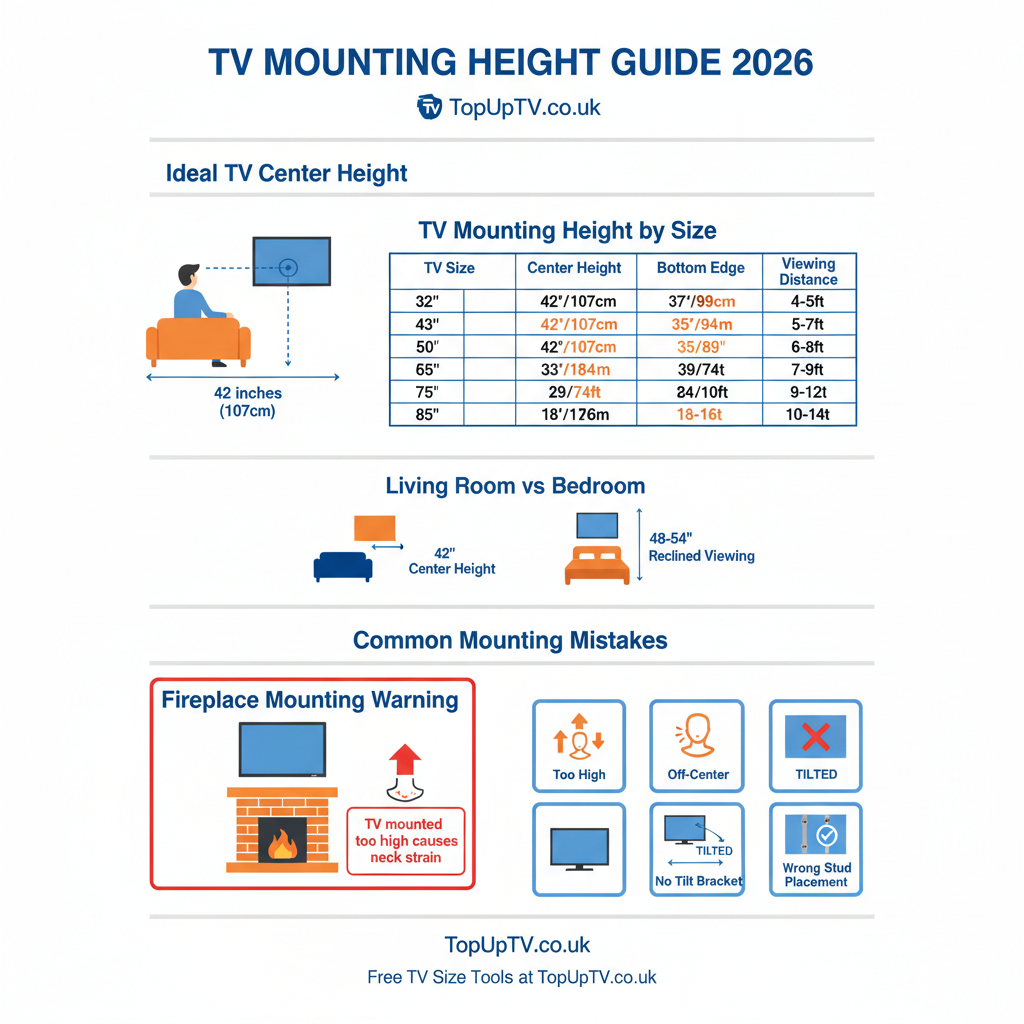
Table of Contents
Free TV Size Tools
Why does TV mounting height matter?
The correct TV mounting height is 42 inches (107 cm) from the floor to the centre of the screen for standard seated viewing. This aligns the screen centre with seated eye level, preventing neck strain. For bedrooms, mount slightly higher at 48–54 inches; for kitchens viewed while standing, target 60–65 inches.
The height at which you mount a TV directly affects comfort, posture, and how long you can watch before experiencing fatigue. A TV mounted at the correct height requires no neck movement — your gaze naturally meets the screen centre without tilting up or down.
A TV mounted too high — one of the most common mistakes, especially above fireplaces — forces viewers to look upward for the entire viewing session. Over time this causes:
- Neck and upper back strain
- Headaches during long viewing sessions
- Distorted perspective on the picture
- Eye fatigue from viewing an angled screen
A TV mounted too low causes a different problem: the picture may be partially obscured by furniture, and leaning forward becomes necessary for extended viewing.
The single most important rule: the centre of the screen should align with your eye level when seated. Everything else follows from this.
What is the ideal eye level for a TV?
Seated eye level is typically between 38 and 44 inches from the floor for an average adult on a standard sofa. The most widely used target is 42 inches (107 cm), which represents the midpoint of this range and works for the vast majority of viewers.
How to Measure Your Eye Level
- Sit in the exact position where you normally watch TV
- Have a second person measure the distance from the floor to the centre of your eye
- Use that measurement as your target TV centre height
If you watch alone and often recline, your effective eye level may be a few inches lower. If you sit upright on a dining chair or barstool, it may be higher. The 42-inch standard works for most situations, but measuring your actual seated eye level takes two minutes and guarantees a perfect result.
The Formula
Bottom edge height = Eye level (42") − (TV height ÷ 2)
Example: 55" TV is ~31" tall → 42 − 15.5 = 26.5" bottom edge
Use our TV Sizes in CM & Inches guide to find the exact physical height of your TV model before mounting.
Mounting height diagram — eye level alignment
What height should each TV size be mounted?
The table below shows the recommended mounting heights for every major TV size, targeting a 42-inch centre height for standard seated viewing.
| TV Size | Centre Height | Bottom Edge Height | Viewing Distance |
|---|---|---|---|
| 32" | 42" (107 cm) | 26" (66 cm) | 4–5 ft |
| 43" | 42" (107 cm) | 21" (53 cm) | 5–7 ft |
| 50" | 42" (107 cm) | 17" (43 cm) | 6–8 ft |
| 55" | 42" (107 cm) | 14" (36 cm) | 7–9 ft |
| 65" | 42" (107 cm) | 6" (15 cm) | 8–10 ft |
| 75" | 44" (112 cm) | 2" (5 cm) | 9–12 ft |
| 85" | 48" (122 cm) | 2" (5 cm)* | 10–14 ft |
* For 75" and 85" TVs, the bottom edge is close to floor level at a 42" centre. We recommend raising the centre to 44–48" and using a tilting bracket to compensate.
For the exact viewing distance to pair with your mounting height, use our Viewing Distance Guide or the Viewing Distance Calculator.
Get your personalised mount recommendation
Answer a few questions to get your ideal TV size, mounting height, VESA pattern, and full setup report — with print, share, and save.
Your Recommended TV Setup
85" QLED
Match score: 100/100
Best size
85"
Viewing distance
7.1–10.6 ft
Best panel
QLED
Mount height
42" center
Room brightness
Medium — any panel works
VESA pattern
600×400
Energy cost
~£83/yr
Weight
~42 kg
Why this fits you
- Perfect size for your viewing distance
- QLED works well for general
- Handles mixed lighting well (1000 nits)
Continue your journey
How high should a living room TV be mounted?
Living rooms are the primary viewing environment for most households. The setup typically involves a sofa positioned 7–12 feet from the TV wall, with viewers sitting upright or semi-reclined.
Standard Living Room Setup
- Target centre height: 42 inches (107 cm) from the floor
- TV unit height impact: If your TV sits on a unit that is 18–20 inches tall, the bottom edge lands naturally near the ideal position for most screen sizes
- Wall mounting vs unit: Wall mounting at the correct height removes the unit entirely, freeing floor space and giving a cleaner look
Open-Plan Living Rooms
Open-plan spaces often have multiple seating positions at different distances. In this case:
- Use the primary viewing position (main sofa) to set the height
- Consider a full-motion mount that allows the TV to swivel toward secondary seating areas
- Verify your wall can support the bracket weight — use our Wall Fit Calculator to check
| Room Type | Typical Sofa Distance | Recommended TV Size | Target Centre Height |
|---|---|---|---|
| Compact living room | 7–9 ft | 50"–55" | 42" (107 cm) |
| Standard living room | 8–10 ft | 55"–65" | 42" (107 cm) |
| Large living room | 9–12 ft | 65"–75" | 42–44" (107–112 cm) |
| Open-plan home | 10–14 ft | 75"–85" | 44–48" (112–122 cm) |
How high should a bedroom TV be mounted?
Bedroom viewing is different from living room viewing in one critical way: most people watch TV in bed from a reclined or propped-up position, which raises the natural eye level by 6–12 inches compared to sofa viewing.
Adjusted Height for Bedroom Viewing
- Seated upright in bed: Target centre height 48–54 inches (122–137 cm)
- Propped on pillows (semi-reclined): Target centre height 44–50 inches (112–127 cm)
- Fully reclined: Target centre height 54–60 inches (137–152 cm)
The range is wide because bedroom viewing postures vary enormously. The best approach is to lie in your normal viewing position and measure where your eyes naturally rest — then mount the TV centre at that height.
In bedrooms, a full-motion tilting bracket is highly recommended because it allows you to angle the screen down toward your eye level regardless of exact height placement.
| Bedroom Type | Viewing Distance | TV Size | Target Centre Height |
|---|---|---|---|
| Small bedroom | 4–6 ft | 32"–43" | 48–52" (122–132 cm) |
| Standard bedroom | 6–8 ft | 43"–55" | 48–54" (122–137 cm) |
| Master bedroom | 8–10 ft | 55"–65" | 50–56" (127–142 cm) |
For more bedroom-specific guidance, see our Best TV Size for Bedroom guide.
Can you mount a TV above a fireplace?
⚠️ Mounting a TV above a fireplace is almost always too high. The average UK fireplace mantel sits 54–60 inches from the floor. This puts the TV centre well above the recommended 42 inches, causing neck strain for every viewing session.
Despite this, above-fireplace TV placement remains popular because it looks architecturally balanced and saves wall space. If you choose this approach, here are the key considerations:
Heat Risk
Heat rises. A working gas or wood fireplace can significantly raise the temperature at TV level, potentially damaging the screen over time. Always check the heat output of your fireplace against the TV manufacturer's maximum ambient temperature specification.
Minimising the Height Problem
- Use a full-motion articulating mount that tilts downward — angling the screen down reduces the effective viewing angle
- Keep your sofa relatively close (8–10 ft) so the angular displacement is less extreme
- Choose a larger TV — a bigger screen is easier to watch at a slight upward angle because detail is visible at greater distances
- Install a mantel shelf above the fireplace to create a visual boundary and help reflect heat away from the screen
When to Avoid It Completely
- Rooms where the sofa sits more than 12 feet away — the upward angle becomes severe
- Working wood-burning fireplaces used regularly
- Rooms where children are the primary viewers — children naturally sit closer, amplifying the angle problem
What height should I mount each TV size?
32-Inch TV
Mount the centre at 42 inches. The bottom edge will sit at approximately 26 inches, which is well above floor level. Ideal for bedrooms, kitchens, and offices where the TV is often viewed from closer than 5 feet.
43-Inch TV
Mount the centre at 42 inches. The bottom edge lands at about 18–21 inches, comfortable above a low TV unit. This is the most versatile size for bedrooms and small living rooms. See our 43 vs 55 Inch TV comparison.
55-Inch TV
Mount the centre at 42 inches. The bottom edge at approximately 11–14 inches is suitable for mounting directly on a wall or above a low-profile unit. At this size, consider a tilting bracket to keep the screen perpendicular to seated eye level. Compare with 65 in our 55 vs 65 Inch TV guide.
65-Inch TV
Mount the centre at 42 inches. The bottom edge sits at approximately 6 inches, which is very close to the floor. If mounting above a unit, measure the unit height and add it to the bottom edge target. A 65-inch TV on a 20-inch unit has its centre at roughly 38 inches — close enough to ideal.
75-Inch TV
At this size, maintaining a 42-inch centre height places the bottom edge just 2–4 inches off the floor, which is impractical for wall mounting. Raise the centre to 44–46 inches and use a downward-tilting bracket to compensate. Read our 75 vs 85 Inch TV guide.
85-Inch TV
An 85-inch TV is approximately 48 inches tall. Mounting the centre at 42 inches is impossible without the bottom edge touching the floor. Target a 48-inch centre height as a minimum, using a tilting mount to direct the screen downward. Always verify your wall can handle the weight with our Wall Fit Calculator.
What are common TV mounting mistakes?
Mounting Too High
The most common error. Driven by aesthetic preference (TVs look impressive high on a wall) rather than ergonomic reality. Even 6 inches too high creates a noticeable upward tilt that becomes tiring during a 2-hour film.
Not Using a Level
A TV mounted even slightly off-horizontal is immediately visible. Always use a spirit level when marking drill points — a few seconds of care prevents a permanent, visible error.
Using a Fixed Mount Instead of Tilting
A flat/fixed mount is only appropriate when the TV is mounted at exactly the right height. A tilting mount costs marginally more and provides the flexibility to correct small height errors and optimise the viewing angle.
Not Hitting Wall Studs
Large TVs can weigh 40–80 lbs (18–36 kg). Anchoring a mount into plasterboard alone — without hitting studs or using appropriate cavity wall fixings — is a safety hazard. Always locate studs or use appropriate heavy-duty fixings rated for the load.
Ignoring Cable Management
A TV mounted on a wall with visible cables hanging down negates most of the aesthetic benefit. Plan cable routing before drilling — in-wall cable channels or surface-mounted conduit are both good solutions.
Not Checking Viewing Distance
Mounting height and viewing distance work together. A TV at the right height but wrong distance still delivers a suboptimal experience. Use our Viewing Distance Guide alongside this height guide.
Keep planning
Recommended Next Steps
Continue planning your TV purchase with these helpful tools and guides.
Bedroom TV Guide
The complete guide to choosing the right TV for your bedroom.
Viewing Distance Calculator
Find the perfect sitting distance for your TV size and resolution.
TV Size Calculator
Answer three quick questions and get your recommended TV size.
TV Stand Fit Checker
Check whether your stand is wide enough to safely hold your TV.
Frequently Asked Questions
What is the ideal height to mount a TV on the wall?
The ideal mounting height places the center of the screen at approximately 42 inches (107 cm) from the floor for a seated viewer. This aligns the screen with average eye level when seated on a standard sofa.
How high should a 65-inch TV be mounted on the wall?
For a 65-inch TV, mount the center of the screen at 42 inches from the floor. A 65-inch TV is approximately 36 inches tall, so the bottom edge would sit at approximately 24 inches from the floor.
How high should a 55-inch TV be mounted?
Mount a 55-inch TV so the center is at 42 inches from the floor. The bottom edge will sit at approximately 11–14 inches above the floor, or higher if placing it above a TV unit.
Should a TV be mounted above a fireplace?
Generally no — a TV above a fireplace is often mounted too high, causing neck strain. The average fireplace mantel is 54–60 inches from the floor, pushing the TV center well above the recommended 42 inches. If you must mount above a fireplace, use a full-motion tilting bracket and keep the distance to your sofa short enough that the angle is manageable.
Is it bad to mount a TV too high?
Yes. Mounting a TV too high forces viewers to tilt their heads back and look upward for extended periods, causing neck and upper back strain. For every 10 degrees above eye level, neck muscle load increases significantly.
How do I calculate TV mounting height?
Measure the height of the TV in inches, divide by 2, then subtract that figure from 42 inches to find the ideal bottom edge height. For example, a 55-inch TV is about 31 inches tall — 42 minus 15.5 equals 26.5 inches for the bottom edge.
Should the TV be at eye level when standing or sitting?
Seated eye level — always. Since most viewing happens from a sofa or chair, the TV should be calibrated to your seated eye level, which is typically 38–44 inches from the floor depending on seat and viewer height.
Does the type of mount affect ideal height?
Yes. A fixed flat mount locks the TV at one angle, so height placement is critical. A full-motion or tilting mount gives you flexibility to angle the screen downward if the TV is mounted slightly higher than ideal, which can help when installing above a TV unit or fireplace.
Related Guides
People Also Ask
Continue Reading
What Size TV Do I Need?
The complete guide to matching TV size to your room and viewing distance.
Read guideViewing Distance Guide
Complete distance chart and calculator for every TV size.
Read guideBest TV Size for Living Room
Room-by-room recommendations with viewing distance charts.
Read guideBest TV Size for Bedroom
Find the perfect bedroom TV by room size and viewing distance.
Read guide55 vs 65 Inch TV Comparison
The most popular comparison — see which size fits your room.
Read guideTV Size Comparison Chart
Compare all TV sizes from 32" to 98" in one master chart.
Read guide