How Far Should You Sit From a TV? Complete Viewing Distance Guide (2026)
The ideal viewing distance depends on TV size, screen resolution, and room type. This guide shows the recommended seating distance for TVs from 32 to 100 inches using THX and SMPTE standards.
Quick Answer
Most viewers should sit approximately:
For the most immersive experience, use the THX recommendations shown below.
Choosing the right TV size is only half the equation. The other half — just as important — is knowing how far to sit from the screen. Sit too close and you risk eye strain and visible pixels. Sit too far and the screen feels small, robbing you of the immersion you paid for.
This guide covers the ideal viewing distance for every major TV size, from 32 inches to 85 inches, using the same professional standards — THX and SMPTE — that cinema installers rely on. Whether you are setting up a bedroom, living room, or home theatre, you will find your exact recommended distance below.
For a personalised calculation, use our Viewing Distance Calculator. To compare two TV sizes side by side, try our TV Size Comparison Tool.
Get your personalised viewing distance
Adjust the options below to get your ideal TV size, viewing distance, panel recommendation, and full setup report — with print, share, and save.
Your Recommended TV Setup
83" QLED
Match score: 100/100
Best size
83"
Viewing distance
6.9–10.4 ft
Best panel
QLED
Mount height
42" center
Room brightness
Medium — any panel works
VESA pattern
600×400
Energy cost
~£75/yr
Weight
~40 kg
Why this fits you
- Perfect size for your viewing distance
- QLED works well for general
- Handles mixed lighting well (1000 nits)
Continue your journey
Common Viewing Distances
Need exact dimensions for your wall or stand? See our TV sizes in CM and inches guide.
What is the recommended viewing distance for each TV size?
Every major TV size from 32" to 100" with minimum, recommended, and THX cinema distances. Click any column header to sort ascending or descending.
| TV Size | Minimum Distance | Recommended Distance | Cinema Distance (THX) |
|---|---|---|---|
| 32" | 3.3 ft | 4–5 ft | 3.9 ft |
| 40" | 4.2 ft | 5–7 ft | 4.9 ft |
| 43" | 4.5 ft | 5–7 ft | 5.3 ft |
| 50" | 5.3 ft | 6–8 ft | 6.2 ft |
| 55" | 5.8 ft | 7–9 ft | 6.8 ft |
| 58" | 6.0 ft | 7–10 ft | 7.1 ft |
| 60" | 6.3 ft | 7–10 ft | 7.4 ft |
| 65" | 6.8 ft | 8–11 ft | 8.0 ft |
| 70" | 7.3 ft | 9–11 ft | 8.6 ft |
| 75" | 7.8 ft | 9–12 ft | 9.2 ft |
| 77" | 8.1 ft | 10–13 ft | 9.5 ft |
| 80" | 8.3 ft | 10–13 ft | 9.8 ft |
| 85" | 8.9 ft | 10–14 ft | 10.5 ft |
| 90" | 9.4 ft | 11–15 ft | 11.1 ft |
| 98" | 10.3 ft | 12–16 ft | 12.1 ft |
| 100" | 10.5 ft | 12–16 ft | 12.3 ft |
Table of Contents
Free TV Size Tools
What Is TV Viewing Distance?
TV viewing distance is the distance between your seating position and the television screen. It is typically measured in feet or metres, and it directly affects how immersive, comfortable, and detailed your viewing experience feels.
The right viewing distance depends on three key factors:
- Screen size — larger TVs require greater distances
- Resolution — 4K TVs allow closer seating than 1080p
- Content type — movies benefit from closer seating; casual TV may prefer more distance
Professional standards from THX and SMPTE provide scientifically backed recommendations based on the field of view — the angle subtended by the screen at your eyes. We cover both standards in detail later in this guide.
Why does viewing distance matter?
Sitting at the correct distance from your TV affects far more than just comfort. It impacts picture quality, immersion, eye health, and even the perceived value of your purchase.
Picture Quality
Sit too far from a 4K TV and you lose the ability to discern the extra detail that 4K provides over 1080p. The entire benefit of a higher resolution screen is only visible within a specific distance range.
Immersion
A larger field of view creates a more immersive, cinema-like experience. THX recommends a 40-degree field of view for cinematic content — the same benchmark used in commercial theatres.
Eye Comfort
Sitting too close forces your eyes to make constant, wide-angle movements to track action across the screen, leading to fatigue. Sitting too far means your eyes work harder to resolve fine detail.
Value for Money
If you sit too far from a large TV, the screen effectively looks the same size as a smaller, cheaper model would at a closer distance. You end up paying for screen area you never actually experience.
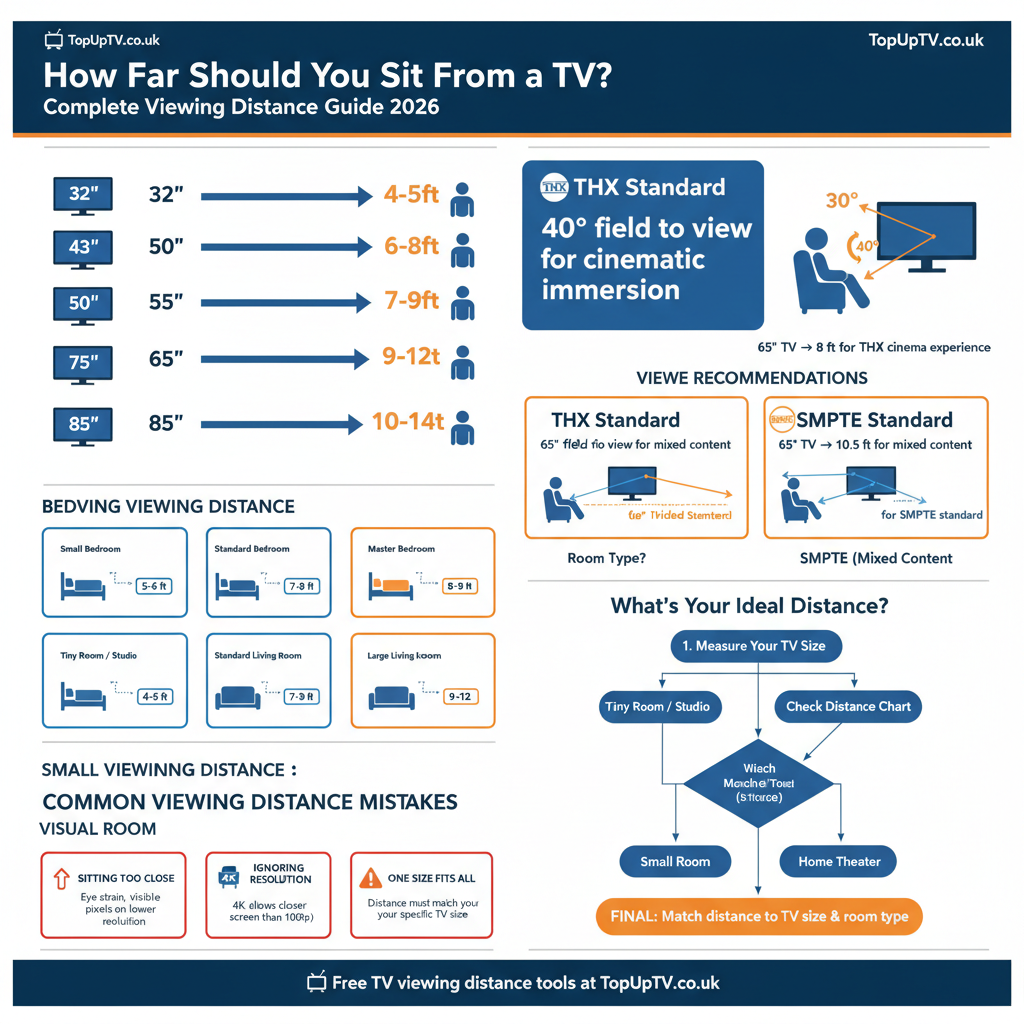
How far should you sit from each TV size?
The chart below shows the recommended viewing distance range for every major TV size. These ranges blend THX and SMPTE standards with practical, real-world comfort.
| TV Size | Recommended Distance | THX Distance | SMPTE Distance |
|---|---|---|---|
| 32" | 4–5 ft (1.2–1.5 m) | 3.9 ft | 5.2 ft |
| 43" | 5–7 ft (1.5–2.1 m) | 5.3 ft | 7.0 ft |
| 50" | 6–8 ft (1.8–2.4 m) | 6.1 ft | 8.2 ft |
| 55" | 7–9 ft (2.1–2.7 m) | 6.8 ft | 9.0 ft |
| 65" | 8–10 ft (2.4–3.0 m) | 8.0 ft | 10.5 ft |
| 75" | 9–12 ft (2.7–3.7 m) | 9.2 ft | 12.1 ft |
| 85" | 10–14 ft (3.0–4.3 m) | 10.5 ft | 13.8 ft |
Viewing distance by TV size — visual chart
THX vs SMPTE field of view (65" TV example)
For a personalised recommendation based on your exact room dimensions, use our Viewing Distance Calculator.
Best Distance for a 32-Inch TV
A 32-inch TV is ideal for small bedrooms, kitchens, and dorm rooms. At 4–5 feet, you get a comfortable viewing experience without eye strain. This size is best suited for casual viewing rather than cinematic immersion.
Best for: small bedrooms, kitchens, home offices, and children's rooms. See our Best TV Size for Small Rooms guide for more.
Best Distance for a 43-Inch TV
A 43-inch TV strikes a balance between immersion and space efficiency. At 5–7 feet, it delivers a satisfying viewing experience in bedrooms and small living rooms without overwhelming the space.
Best for: bedrooms, small living rooms, and studio apartments. Compare it directly with a 55-inch in our 43 vs 55 Inch TV guide.
Best Distance for a 50-Inch TV
A 50-inch TV is a versatile mid-size option. At 6–8 feet, it provides solid immersion for medium-sized rooms. It is a popular choice for bedrooms and smaller living rooms where a 55-inch might feel slightly too large.
Best for: medium bedrooms, compact living rooms, and apartments.
Best Distance for a 55-Inch TV
A 55-inch TV is one of the most popular screen sizes in the UK. At 7–9 feet, it delivers an immersive experience for most living rooms and larger bedrooms. For THX cinema-level immersion, sit as close as 6.8 feet.
Best for: standard living rooms, master bedrooms, and open-plan apartments. See how it compares to a 65-inch in our 55 vs 65 Inch TV guide.
Best Distance for a 65-Inch TV
A 65-inch TV is the sweet spot for modern living rooms. At 8–10 feet, it fills your field of view for a genuinely cinematic experience. THX recommends approximately 8 feet for full cinema immersion, while SMPTE suggests 10.5 feet for mixed content.
Best for: main living rooms, family rooms, and home theatres. This is the most recommended size for the average UK living room. See our Best TV Size for Living Room guide for more.
Best Distance for a 75-Inch TV
A 75-inch TV creates a true cinema experience at home. At 9–12 feet, the screen fills a large portion of your field of view. This size requires a sufficiently large room — sitting closer than 9 feet can feel overwhelming for some viewers.
Best for: large living rooms and dedicated home theatres. Compare it with an 85-inch in our 75 vs 85 Inch TV guide.
Best Distance for an 85-Inch TV
An 85-inch TV is a statement piece designed for large spaces. At 10–14 feet, it delivers a genuinely immersive, cinema-scale experience. This size requires a substantial room — most standard UK living rooms can accommodate it, but always verify your wall space first.
Best for: large living rooms, open-plan spaces, and dedicated home cinema rooms. Check your wall fit with our Wall Fit Calculator.
What are the THX and SMPTE viewing distance standards?
Two professional standards govern TV viewing distance recommendations: THX and SMPTE. Both are based on the field of view — the angle the screen subtends at the viewer's eyes — but they differ in their target experience.
THX Standard
THX recommends a 40-degree field of view for cinematic content. This is the same standard used in commercial cinemas. It means sitting closer to the screen for maximum immersion, where the screen fills a large portion of your peripheral vision.
THX distances are ideal for:
- Watching movies and cinematic content
- Home theatre setups
- Viewers who prioritise immersion
SMPTE Standard
SMPTE (Society of Motion Picture and Television Engineers) recommends a 30-degree field of view for mixed content. This means sitting farther back, which is more comfortable for general TV watching, sports, and casual viewing.
SMPTE distances are ideal for:
- Mixed content (TV shows, news, sports)
- Family rooms with multiple viewers
- Viewers who prioritise comfort over immersion
Which Should You Use?
If you primarily watch movies and want a cinema-like experience, use the THX distance (the closer end of the range). If you watch a mix of content or have multiple people viewing from different angles, use the SMPTE distance (the farther end of the range). Most people are happiest somewhere in the middle — which is why our chart provides a range rather than a single number.
For a precise field-of-view score based on your exact setup, try our Cinematic Immersion Estimator.
What is the best viewing distance for a bedroom TV?
Bedrooms typically have shorter viewing distances than living rooms because the bed-to-wall distance is usually 5–10 feet. Here are the best TV sizes and distances for bedroom setups:
| Bedroom Type | Typical Distance | Recommended TV Size |
|---|---|---|
| Small bedroom | 4–6 ft | 32"–43" |
| Standard bedroom | 6–8 ft | 43"–55" |
| Master bedroom | 8–10 ft | 55"–65" |
In bedrooms, most people watch from a reclined or semi-reclined position. This means the TV is often mounted slightly higher on the wall to maintain a comfortable viewing angle. Always account for this when measuring your distance.
For detailed bedroom-specific guidance, see our Best TV Size for Bedroom guide.
What is the best viewing distance for a living room TV?
Living rooms offer more flexibility than bedrooms, with typical viewing distances of 7–12 feet. Here are the best TV sizes and distances for living room setups:
| Living Room Type | Typical Distance | Recommended TV Size |
|---|---|---|
| Compact living room | 7–9 ft | 50"–55" |
| Standard living room | 8–10 ft | 55"–65" |
| Large living room | 9–12 ft | 65"–75" |
| Open-plan / home theatre | 10–14 ft | 75"–85" |
In living rooms, consider how many people will be watching. A wider seating arrangement means some viewers will be off-axis, so a slightly larger TV can help maintain immersion for everyone. Always verify your wall can accommodate the TV width using our Wall Fit Calculator.
For comprehensive living room guidance, see our Best TV Size for Living Room guide.
Common Viewing Distance Mistakes
Sitting Too Close
Sitting closer than the recommended range can cause eye strain, neck fatigue from wide eye movements, and — on lower-resolution screens — visible pixel structure. On 4K TVs, pixel visibility is less of an issue, but physical comfort still matters.
Sitting Too Far
Sitting farther than the recommended range reduces immersion and makes the screen feel smaller than it is. You lose the cinematic experience and may struggle to see fine detail, especially with 4K content that is designed to be viewed closer.
Ignoring Resolution
4K TVs allow closer seating than 1080p models because the higher pixel density means you cannot see individual pixels at closer distances. If you are upgrading from 1080p to 4K, you can either sit closer or choose a larger TV for the same room.
One Size Fits All
Viewing distance is not a universal number — it must be matched to your specific TV size. A distance that works perfectly for a 55-inch TV will feel completely wrong for a 75-inch TV. Always check the chart for your specific screen size.
Forgetting About Stand Height
If your TV is on a stand rather than wall-mounted, the height of the stand affects the effective viewing angle. A TV that is too low or too high can cause neck strain even at the correct distance. Use our Stand Checker to verify compatibility.
Frequently Asked Questions
How far should you sit from a 55 inch TV?
The ideal viewing distance for a 55-inch TV is between 7 and 9 feet (2.1–2.7 metres). For a cinematic THX experience, sit around 6.8 feet; for SMPTE mixed-content viewing, around 9 feet.
How far should you sit from a 65 inch TV?
For a 65-inch TV, sit between 8 and 10 feet (2.4–3.0 metres) away. THX recommends approximately 8 feet for cinematic immersion, while SMPTE suggests around 10.5 feet for general viewing.
How far from a 75 inch TV should you sit?
A 75-inch TV is best viewed from 9 to 12 feet (2.7–3.7 metres). For THX cinema standards, sit around 9.2 feet; for SMPTE standards, approximately 12.1 feet.
What is the best viewing distance for a 43 inch TV?
A 43-inch TV is best viewed from 5 to 7 feet (1.5–2.1 metres). This makes it ideal for small bedrooms, dorm rooms, and compact living spaces.
Does 4K resolution change the viewing distance?
Yes. 4K TVs allow you to sit closer than 1080p models without seeing individual pixels. This means you can choose a larger TV for the same room and sit closer for greater immersion.
What happens if you sit too close to a TV?
Sitting too close can cause eye strain, fatigue, and — on lower-resolution screens — visible pixel structure. On 4K TVs, sitting too close is less of a visual issue but can still cause neck discomfort from wide eye movements.
What happens if you sit too far from a TV?
Sitting too far reduces immersion and makes the screen feel smaller than it is. You lose the cinematic experience and may struggle to see fine detail, especially with 4K content designed for closer viewing.
Are THX and SMPTE viewing distances the same?
No. THX recommends a 40-degree field of view for cinematic immersion, which means sitting closer. SMPTE recommends a 30-degree field of view for mixed content, which means sitting farther back. THX distances are roughly 75% of SMPTE distances.
Final Recommendations
The right viewing distance transforms your TV from a screen into an experience. Here is a quick summary of the key principles:
- Match distance to screen size — use the chart above for your specific TV
- Use THX distances for movies — sit closer for cinematic immersion
- Use SMPTE distances for mixed content — sit farther for casual viewing
- Account for 4K resolution — you can sit closer than you could with 1080p
- Consider your room type — bedrooms need shorter distances, living rooms can go larger
- Always measure before buying — verify your wall and stand can accommodate the TV
A few minutes of measuring and planning can mean the difference between a TV that feels just right and one that feels slightly wrong for years to come.
Before making your final decision, use our free tools to verify your choice: the Viewing Distance Calculator for a personalised distance, the TV Size Comparison Tool to compare sizes, and the Wall Fit Calculator to check your wall space.
Related Guides
People Also Ask
Continue Reading
What Size TV Do I Need?
The complete guide to matching TV size to your room and viewing distance.
Read guideBest TV Size for Living Room
Room-by-room recommendations with viewing distance charts.
Read guideBest TV Size for Gaming
PS5, Xbox, and Switch 2 — find the ideal gaming TV size.
Read guideBest TV Size for Movies
Home cinema guide with OLED vs Mini LED and THX standards.
Read guideTV Mounting Height Guide
Find the correct mounting height for your seating position.
Read guideViewing Distance Calculator
Get a personalised recommendation based on your exact distance.
Read guide